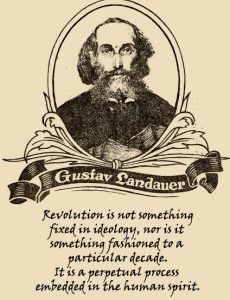
 Our discussion following Social War on Stolen Native Land: Anarchist Contributions brought us to discuss the differences in social and individualist anarchism, which naturally brought us to “Through Separation to Community” by German anarchist Gustav Landauer (1870-1919). We visited this work previously, back in 2019. Landauer is best known for arguing the State is “a condition, a certain relationship between human beings, a mode of human behaviour; we destroy it by contracting other relationships, by behaving differently.” Novelist, playwright, author of three theoretical works and editor of the anarchist newspaper, Der Sozialist (intermittently published between 1893-1899; 1909-1915), he endured frequent stints in prison before the outbreak of World War One. Landauer anticipated the war would lead to revolutionary uprisings and, in November 1918, when workers and soldiers rose up and overthrew the conservative government of Germany’s second largest state, Bavaria, he joined the effort.
Landauer’s writings were very influential and his advocacy of decentralized self-governance based on local councils had an impact. When a new Council-based government was declared by revolutionaries in Bavaria’s capital, Munich, on April 7, 1919, Landauer accepted the appointment of Minister of Culture and Education. The German army immediately mobilized militias of demobilized soldiers, who marched into Munich and took over. A wave of terrorism ensued as revolutionaries were rounded up and shot. Landauer was arrested, jailed and brutally killed by a gang of soldiers on May 2, 1919.
Get the reading here: Gustav Landauer – Through Separation to Community
As always, we are meeting at Camas Books, 2620 Quadra Street, on Lekwungen Territory. The next meeting is Sunday May 28 @ 6:30PM.
 Our study of Indigenous anarchist movements abroad has encouraged us to more closely study the theory and solidarity actions for settler-Indigenous solidarity coming out of so-called “Canada.” The zine Social War on Stolen Native Land: Anarchist Contributions from Black Banner Distro (2017) engages with an alternative perspective that assumes that people have their own valid reason for struggling, and that by coming together from a shared position, we can have stronger and more powerful relationships. Through the lens of past anarchist activity in Canada, the zine explores the ways – both theoretical and practical – in which settler anarchists have attempted historically to act in solidarity with Indigenous resistance.
 Last time we discussed misogyny pervasive in our society and permeating into leftist and anarchist organizing, as well as Subcomandante Marcos’ rejection of representative vanguardist politics. This led us to read more into democratic Indigenous organizing, as well as a companion piece that follows an Indigenous-settler anarcha-feminist group’s perspective.
  After our enthusiastic conversation about the Zapitistas’ model of Participatory Democracy, we wanted to delve more into Zapatista cosmovisión (worldview) and organization by reading Subcomandante Marcos’s “I Shit On All the Revolutionary Vanguards of this Planet,” which is a response to the Basque liberation movement Euskadi Ta Askatasuna’s (ETA) advocation of vanguardist politics. We also teased out the idea of future readings about Rojava in a continuation of our exploration of democratic centralism. Therefore, we decided in anticipation to also include the Feminist Anarchist Border Opposition’s Why Misogynists Make Great Informants, which tackles misogyny and gender violence in left-activist circles and movements.
 Our next reading will be the academic article Participatory Democracy in Action: Practices of the Zapatistas and the Movimento Sem Terra, which covers the Zapatistas’ and Movimento Sem Terra’s (Landless Movement-MST) methods of organizing through participatory democracy, which emphasizes obligation to participate in decision making and a shared concern for autonomy.
 Over the past few weeks we have been reading Peter Gelderloos’ How Nonviolence Protects the State and the discussions have been riveting! This book has both strong points to make in favour of diversity of tactics, but unfortunately, it also has its limitations, which we are unpacking.
 The next Anarchist Reading Circle will be a movie night, scheduled for Sunday, Feb 19th @ 6:30 pm.
 “On Revolution and Equilibrium” by Barbara Deming extensively quotes Frantz Fanon to argue for revolutionary non-violence. Instead of attesting to some imaging sense of ‘purity’ she states it is more important to avoid becoming ‘dizzy’ than to aspire to be pure. What kind of future do we want? Who will be involved in building this future? These are the questions Deming asks while putting Fanon forward to argue for a blance between self-assertion and respect for others.
 The next reading is a chapter by the philosopher Hannah Arendt, who escaped Nazi persecution by fleeing from Germany to the United States. This essay contains her most valuable analysis on power, and she breaks down the differences between power, strength, force, authority, and lastly, violence.
 We are taking a break over the holidays but wanted to provide a follow up reading to