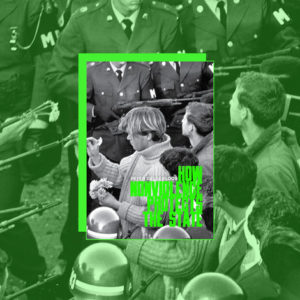
 Over the past few weeks we have been reading Peter Gelderloos’ How Nonviolence Protects the State and the discussions have been riveting! This book has both strong points to make in favour of diversity of tactics, but unfortunately, it also has its limitations, which we are unpacking.
We are accessing the text on one of two ways:
- Online: https://theanarchistlibrary.org/library/peter-gelderloos-how-nonviolence-protects-the-state
- Buy the Book from the publisher, Detritus: https://detritusbooks.com/products/how-nonviolence-protects-the-state-by-peter-gelderloos
Camas Books made a special order from Detritus already. Thanks to those who participated in this bulk purchase.
Reading Assignments
March 5: Part One: Terminology; Part Two: Nonviolence is Ineffective; and Part Three: Nonviolence is Racist.
March 19: Part Four: Nonviolence is Statist; and Part Five: Nonviolence is Patriarchal
As always, we meet at 6:30 pm at Camas Books, 2620 Quadra Street, unceded Lekwungen Territory.
 The next Anarchist Reading Circle will be a movie night, scheduled for Sunday, Feb 19th @ 6:30 pm.
 “On Revolution and Equilibrium” by Barbara Deming extensively quotes Frantz Fanon to argue for revolutionary non-violence. Instead of attesting to some imaging sense of ‘purity’ she states it is more important to avoid becoming ‘dizzy’ than to aspire to be pure. What kind of future do we want? Who will be involved in building this future? These are the questions Deming asks while putting Fanon forward to argue for a blance between self-assertion and respect for others.
 The next reading is a chapter by the philosopher Hannah Arendt, who escaped Nazi persecution by fleeing from Germany to the United States. This essay contains her most valuable analysis on power, and she breaks down the differences between power, strength, force, authority, and lastly, violence.
 We are taking a break over the holidays but wanted to provide a follow up reading to
 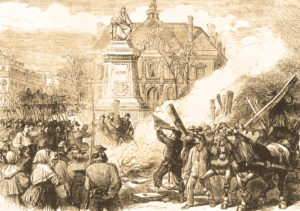 Our discussion turned from anarchy in international relations towards wanting to learn more about the history of anarchist revolutionaries. Thanks to the anarchists at Crimethinc (who need your support right now, as they are being targeted by far-right trolls and billionaires) we decided on learning more about why anarchists burned the guillotine during the Paris Commune of 1871. We have two readings for the next meeting, the first by Crimethinc is the primary reading we will discuss. The second is optional, and provides a detailed historical chronology and background to the Paris Commune.

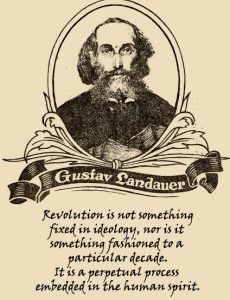 This week we are reading “Through Separation to Community” by German anarchist Gustav Landauer (1870-1919). Landauer is best known for arguing the State is “a condition, a certain relationship between human beings, a mode of human behaviour; we destroy it by contracting other relationships, by behaving differently.” Novelist, playwright, author of three theoretical works and editor of the anarchist newspaper, Der Sozialist (intermittently published between 1893-1899; 1909-1915), he endured frequent stints in prison before the outbreak of World War One. Landauer anticipated the war would lead to revolutionary uprisings and, in November 1918, when workers and soldiers rose up and overthrew the conservative government of Germany’s second largest state, Bavaria, he joined the effort.
  For the next reading, we are looking at the first part of The Coming Insurrection. You can find the whole text here – but remember, in preparation for Aug 13th, we are reading circles 1 to 4.