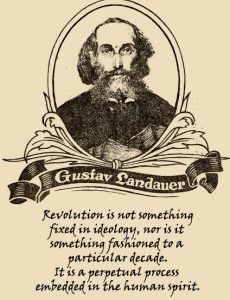
 This week we are reading “Through Separation to Community” by German anarchist Gustav Landauer (1870-1919). Landauer is best known for arguing the State is “a condition, a certain relationship between human beings, a mode of human behaviour; we destroy it by contracting other relationships, by behaving differently.” Novelist, playwright, author of three theoretical works and editor of the anarchist newspaper, Der Sozialist (intermittently published between 1893-1899; 1909-1915), he endured frequent stints in prison before the outbreak of World War One. Landauer anticipated the war would lead to revolutionary uprisings and, in November 1918, when workers and soldiers rose up and overthrew the conservative government of Germany’s second largest state, Bavaria, he joined the effort.
Landauer’s writings were very influential and his advocacy of decentralized self-governance based on local councils had an impact. When a new Council-based government was declared by revolutionaries in Bavaria’s capital, Munich, on April 7, 1919, Landauer accepted the appointment of Minister of Culture and Education. The German army immediately mobilized militias of demobilized soldiers, who marched into Munich and took over. A wave of terrorism ensued as revolutionaries were rounded up and shot. Landauer was arrested, jailed and brutally killed by a gang of soldiers on May 2, 1919.

As per usual, we are meeting at Camas Books and Infoshop, on unceded Lekwungen Territory, 2620 Quadra Street. The doors will be open at 6:50pm, with the discussion beginning at 7pm.
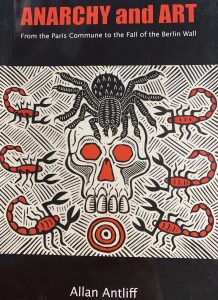 Our last meeting sparked a lively discussion around art and it’s role in anarchism and resistance. For our next reading we will explore a chapter from Anarchy and Art written by local author, and all around good guy Allan Antliff. In this chapter Allan interviews one of “Anarchism’s better-known contemporary artists”, Susan Simensky and explores the intersection of art, anarchy, and activism. YOU can find a .pdf to download and read for your self on the right hand side of our website.
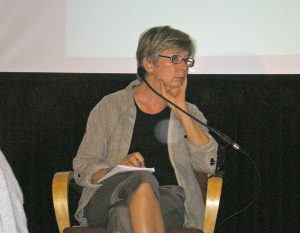 For the next anarchist reading circle, we will be discussing a selection from Barbara Ehrenreich’s Dancing in the Streets: A history of Collective Joy. A history of how the European peasantry was itself colonized and de-paganized by the Church (and particularly by the Reformation and Enlightenment values), pointing to a discussion of how people of European descent can ‘re-indigenize’.
 Our next reading circle is scheduled for Tuesday, February 26th from 6:45 – 9pm; discussion starts at 7pm. As always, we meet on unceded Lekwungen territory at Camas Books and Infoshop (2620 Quadra Street).