 In honour of the late trailblazing Diné anarchist and land defender Klee Benally who joined the ancestors last month, we will be reading and discussing his groundbreaking zine Unknowable: Against an Indigenous Anarchist Theory.
Klee builds upon existing work by Aragorn! on Locating an Indigenous Anarchism, identifying natural affinities and alliances between Indigenous cosmologies and Anarchism. He also touches on the anti-Indigenous racism in the American left-anarchist scene, both in history and the contemporary.
Klee explains “Indigenous autonomy needs no theoretical foundation to justify itself” and renounces the fixture of “anarcho-Indigenous” as a revolutionary appendage to settler anarchism. Klee suggested doing so runs the risk of having an Indigenous Anarchism as something eventually locked in old theory belonging to settler linear time “in the past,” no longer able to stay relevant like other cemented settler anarchisms. He asserts that if an Indigenous Anarchism is to exist, it should not adhere to settler politics or conceptions of time. It should be adaptable, dynamic, fluid, unmappable, unknowable.
The zine is available to read or download on Indigenous Action’s website: https://www.indigenousaction.
Both versions available on the website are here as well: zine format for printing and readable format for screen reading.
As always, we meet at Camas Books and Infoshop, 2620 Quadra Street, on unceded Lekwungen Territory at 6:30pm on Sunday February 4th.
 Next circle, we are reading Chapter Six, titled, “Homeland: Anarchy and Joint Struggle in Palestine/Israel” by Uri Gordon. This is the final chapter in Anarchy Alive! (2008) and it offers insights on the issues, challenges, and movements involved in solidarity and direct action struggles within occupied and contested State forms. This will be a good reading to do in preparation for the talk on the 28th.
 Spilling over from our discussion on how “
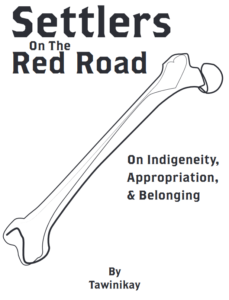
 Our study of Indigenous anarchist movements abroad has encouraged us to more closely study the theory and solidarity actions for settler-Indigenous solidarity coming out of so-called “Canada.” The zine Social War on Stolen Native Land: Anarchist Contributions from Black Banner Distro (2017) engages with an alternative perspective that assumes that people have their own valid reason for struggling, and that by coming together from a shared position, we can have stronger and more powerful relationships. Through the lens of past anarchist activity in Canada, the zine explores the ways – both theoretical and practical – in which settler anarchists have attempted historically to act in solidarity with Indigenous resistance.
 Last time we discussed misogyny pervasive in our society and permeating into leftist and anarchist organizing, as well as Subcomandante Marcos’ rejection of representative vanguardist politics. This led us to read more into democratic Indigenous organizing, as well as a companion piece that follows an Indigenous-settler anarcha-feminist group’s perspective.
 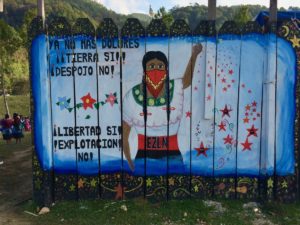 After our enthusiastic conversation about the Zapitistas’ model of Participatory Democracy, we wanted to delve more into Zapatista cosmovisión (worldview) and organization by reading Subcomandante Marcos’s “I Shit On All the Revolutionary Vanguards of this Planet,” which is a response to the Basque liberation movement Euskadi Ta Askatasuna’s (ETA) advocation of vanguardist politics. We also teased out the idea of future readings about Rojava in a continuation of our exploration of democratic centralism. Therefore, we decided in anticipation to also include the Feminist Anarchist Border Opposition’s Why Misogynists Make Great Informants, which tackles misogyny and gender violence in left-activist circles and movements.
 Our next reading will be the academic article Participatory Democracy in Action: Practices of the Zapatistas and the Movimento Sem Terra, which covers the Zapatistas’ and Movimento Sem Terra’s (Landless Movement-MST) methods of organizing through participatory democracy, which emphasizes obligation to participate in decision making and a shared concern for autonomy.
 “On Revolution and Equilibrium” by Barbara Deming extensively quotes Frantz Fanon to argue for revolutionary non-violence. Instead of attesting to some imaging sense of ‘purity’ she states it is more important to avoid becoming ‘dizzy’ than to aspire to be pure. What kind of future do we want? Who will be involved in building this future? These are the questions Deming asks while putting Fanon forward to argue for a blance between self-assertion and respect for others.