 June is Pride month. As some queer anarchists at Crimethinc have said: “Stonewall [Pride] was a violent, leaderless, multiracial, joyous and youthful anti-police riot” spearheaded by BIPOC trans women. For Pride, we have decided to discuss two queer readings.
These readings are (linked) Queers Read This (1990), an essay from Queer Nation distributed as radical pamphlets at Pride events arguing queerness as inherently political and confrontational to cishet hegemonic state authority, and Female Socialization is a Transphobic Myth (2021) by Devon Price Ph.D., which argues against the transphobic talking point.
Edit: Some folks are reporting a paywall on Female Socialization is a Transphobic Myth. Here is a rich text format copy below if you’re unable to access Medium.
Female Socialization is a Transphobic Myth
As always, we are meeting at Camas Books, 2620 Quadra Street, on Lekwungen Territory. The next meeting is Sunday June 25 @ 6:30PM.
 Last week, we read Gustav Landuaer’s Through Separation to Community and decided to swing around to Murray Bookchin’s ideas of social ecology and revolutionary thought. Social ecology is based on the conviction that nearly all of our present ecological problems originate in deep- seated social problems, and is an approach to society that embraces an ecological, reconstructive, and communitarian view on society. Murray Bookchin (1921 – 2006) was an anti-capitalist and advocated for social decentralization along ecological and true democratic lines. His ideas have influenced social movements since the 1960s, including the New Left, the anti-nuclear movement, the anti-globalization movement, Occupy Wall Street, and more recently, the democratic confederalism of the Autonomous Administration of North and East Syria (Rojava.)
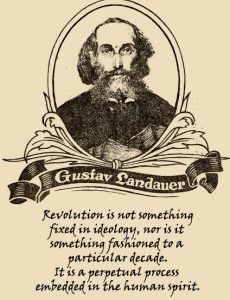 Our discussion following Social War on Stolen Native Land: Anarchist Contributions brought us to discuss the differences in social and individualist anarchism, which naturally brought us to “Through Separation to Community” by German anarchist Gustav Landauer (1870-1919). We visited this work previously, back in 2019. Landauer is best known for arguing the State is “a condition, a certain relationship between human beings, a mode of human behaviour; we destroy it by contracting other relationships, by behaving differently.” Novelist, playwright, author of three theoretical works and editor of the anarchist newspaper, Der Sozialist (intermittently published between 1893-1899; 1909-1915), he endured frequent stints in prison before the outbreak of World War One. Landauer anticipated the war would lead to revolutionary uprisings and, in November 1918, when workers and soldiers rose up and overthrew the conservative government of Germany’s second largest state, Bavaria, he joined the effort.
 Our study of Indigenous anarchist movements abroad has encouraged us to more closely study the theory and solidarity actions for settler-Indigenous solidarity coming out of so-called “Canada.” The zine Social War on Stolen Native Land: Anarchist Contributions from Black Banner Distro (2017) engages with an alternative perspective that assumes that people have their own valid reason for struggling, and that by coming together from a shared position, we can have stronger and more powerful relationships. Through the lens of past anarchist activity in Canada, the zine explores the ways – both theoretical and practical – in which settler anarchists have attempted historically to act in solidarity with Indigenous resistance.
 Last time we discussed misogyny pervasive in our society and permeating into leftist and anarchist organizing, as well as Subcomandante Marcos’ rejection of representative vanguardist politics. This led us to read more into democratic Indigenous organizing, as well as a companion piece that follows an Indigenous-settler anarcha-feminist group’s perspective.
  After our enthusiastic conversation about the Zapitistas’ model of Participatory Democracy, we wanted to delve more into Zapatista cosmovisión (worldview) and organization by reading Subcomandante Marcos’s “I Shit On All the Revolutionary Vanguards of this Planet,” which is a response to the Basque liberation movement Euskadi Ta Askatasuna’s (ETA) advocation of vanguardist politics. We also teased out the idea of future readings about Rojava in a continuation of our exploration of democratic centralism. Therefore, we decided in anticipation to also include the Feminist Anarchist Border Opposition’s Why Misogynists Make Great Informants, which tackles misogyny and gender violence in left-activist circles and movements.