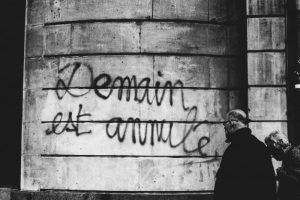
 For the next reading, we are looking at the first part of The Coming Insurrection. You can find the whole text here – but remember, in preparation for Aug 13th, we are reading circles 1 to 4.
https://theanarchistlibrary.org/library/comite-invisible-the-coming-insurrection#toc1
The Coming Insurrection is a work written by The Invisible Committee, which describes a general disgust with the dominant politics, economies, and societies of early 21st century civilization. The Committee are harshly critical of capitalism, states, the police, and the world economy, and which they argue are the root causes of much of the suffering in the world. In response, they specifically advocate insurrectionary anarchism as the best available means to bring about the sort of world in which they would prefer to live: a world populated by communes, based in immediate social ties, and friendship – simpler, more concrete human interactions, as opposed to the more abstract political concepts of citizenship, or of a sovereign state.
The Coming Insurrection is divided into two halves. The first half of the book describes and diagnoses a series of dysfunctions in modern capitalist society, in terms of social alienation. Using the nine circles of hell of Dante’s Inferno as a metaphor for the various types of social ills which exist in the world, the work describe seven circles, or areas of society which this alienation negatively affects, including the self, work life, and the natural environment.
As per usual, we are meeting at Camas Books and Infoshop, on unceded Lekwungen Territory, 2620 Quadra Street. This meeting will be held on Tuesday, Aug 13th, 2019. The doors will be open at 6:50pm, with the discussion beginning at 7pm.


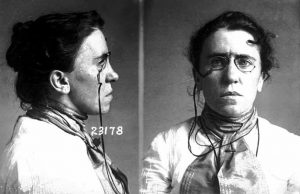
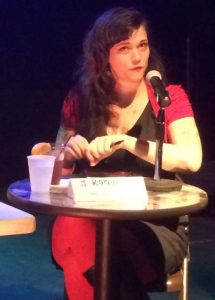 In this 2012 article, J. Rogue examines the history of essentialism in anarchist and socialist feminist movements. Through transfeminist critiques of essentialist viewpoints, Rogue delivers a powerful statement and call to action for all anarchists to “integrate the principles of (trans)feminism into our organizing within the working class and social movements”.
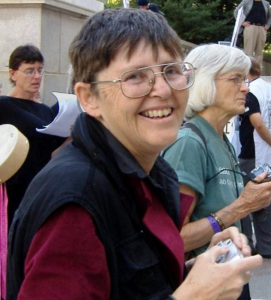 o Freeman this essay explores power relations within radical feminist collectives and was inspired by her time in the Women’s Liberation Movement of the 1960’s. Joreen reflected on the experiments of the feminist movement in resisting the idea of leaders and even discarding any structure or division of labor. Freeman described how “this apparent lack of structure too often disguised an informal, unacknowledged and unaccountable leadership that was all the more pernicious because its very existence was denied”. As a solution, Freeman suggests formalizing the existing hierarchies in the group and subjecting them to democratic control.
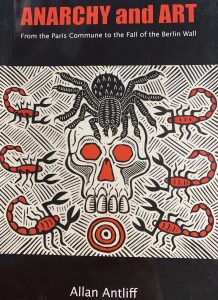 Our last meeting sparked a lively discussion around art and it’s role in anarchism and resistance. For our next reading we will explore a chapter from Anarchy and Art written by local author, and all around good guy Allan Antliff. In this chapter Allan interviews one of “Anarchism’s better-known contemporary artists”, Susan Simensky and explores the intersection of art, anarchy, and activism. YOU can find a .pdf to download and read for your self on the right hand side of our website.
 For the next anarchist reading circle, we will be discussing a selection from Barbara Ehrenreich’s Dancing in the Streets: A history of Collective Joy. A history of how the European peasantry was itself colonized and de-paganized by the Church (and particularly by the Reformation and Enlightenment values), pointing to a discussion of how people of European descent can ‘re-indigenize’.
 For the next anarchist reading circle, we will be discussing Rebecca Solnit’s ‘A Paradise Built in Hell: The extraordinary communities that arise in disaster.’ During our last session we had a discussion about the whole ‘pessimistic/optimistic’ debate regarding human nature, whether or not our intrinsic sociability or orientation to help each other would arise in the event of system collapse (or if we even have such an orientation), etc.